the wandered

Magical Evening in a Traditional Arabian Souk

A vibrant night scene in a beautifully lit traditional Arabian marketplace. Strings of warm fairy lights drape across the sky, creating a magical atmosphere over the bustling outdoor café area. People in traditional attire enjoy the evening, walking along the stone-paved streets and relaxing at tables surrounded by charming architecture and potted plants. The glowing shop signs and festive lighting make this a perfect evening destination for food, culture, and ambiance.

A Strange but Fascinating Road Trip Across Northwestern Saudi Arabia

0

views icon
Viacheslav Nikitenko

Viacheslav Nikitenko

Traveler, editor-in-chief of the blog The Wandered, entrepreneur, co-founder and CEO of the Your Price Booking.

I recently came across a fascinating travel report from someone who drove nearly 1,300 miles (≈ 2,100 km) across northwestern Saudi Arabia — from Jeddah to AlUla, Wadi Disah, Umluj, and back to Jeddah. Completely independent, self-driven, without guides (except where mandatory for archaeological sites).

Here’s a summarized, re-written version of that journey — capturing the key impressions of traveling through a country that has only recently opened up to tourism and is still in the process of rebuilding its infrastructure and hospitality scene.


Highlights and Challenges


What impressed the traveler

  • Nature and heritage: AlUla and Hegra are breathtaking — tombs carved into rock cliffs, beautifully preserved. Jabal Ikmah, the so-called “open-air library,” features inscriptions over 5,000 years old. Dadan is still being excavated but already impressive. It all feels genuinely magical.
  • Hotel experience: Banyan Tree AlUla is a stunning luxury resort — scenery, service, and atmosphere are all top-tier. Off-season prices are much friendlier than during peak months.
  • Feeling of safety: Even as a foreign couple, the traveler reported feeling very safe. Locals were kind and eager to help, though the language barrier is noticeable.


What was difficult

  • Infrastructure outside tourist zones is still underdeveloped. For instance, in Wadi Disah there’s basically only one hotel with an online presence; few staff speak English; cleanliness is hit-or-miss.
  • Driving conditions: chaotic and sometimes dangerous — drivers cut lanes, unexpected speed bumps, limited signage. You must stay alert.
  • Limited services: few restaurants, gas stations, or shops in remote areas. If something goes wrong (e.g., car trouble), you’re on your own.


Costs, Transport, and Comfort

  • 4WD car rental (Geely Tugella) cost around $75 per day. A high-clearance or 4WD vehicle is essential — you’ll need it on the rougher roads.
  • Fuel is cheap by international standards.
  • Mid-range hotels average $80–100 per night; luxury villas and resorts can reach $500+, but service is excellent.
  • Food prices vary: simple meals cost just a few dollars, while hotel restaurants can be expensive.


Overall impression

The trip report sums it up well: AlUla is a must-see. If you have the time, budget, and curiosity — go.

But Saudi Arabia is still not an easy-mode destination; it’s better suited for experienced, independent travelers comfortable with some uncertainty. For those seeking fully developed tourist comfort, waiting a few years might make sense.


💬 Community reactions

  • Travelers note that towns like Al Wajh or Al Disah often have no hotels or only one basic option, sometimes without online listings.
  • Major booking platforms like Booking.com and Agoda work fine in larger cities, but coverage in rural areas is patchy.
  • Safety and openness have improved a lot in recent years — reforms have made travel easier, especially for women — but experiences still vary depending on location.
  • Many travelers recommend contacting hotels directly by phone or WhatsApp for confirmation or better local rates, since some listings online may be inaccurate.


Hotel chains and booking platforms in Saudi Arabia

Based on recent hospitality market reports and online sources, here’s who’s active in the Kingdom and how they compare.


International & local hotel groups

  • Global chains: Marriott International, Hilton, IHG, Accor — all expanding rapidly, not only in Riyadh, Jeddah, and Medina but also in new tourist destinations like AlUla.


  • Regional / local brands: locally managed hotels, mid-range and boutique properties; new collaborations emerging (e.g. AlUla Development Company with Marriott and Six Senses).


  • TIME Hotels — a UAE-based group also present in Saudi Arabia.


🌐 Booking and accommodation platforms

Platform Pros / Features Limitations

Almosafer

Saudi-owned platform focusing on local travelers; frequent discounts; Arabic & English interface; offers flexible payment and “buy-now-pay-later” options.

Some listings only in Arabic; limited rural coverage.

Booking.com

Large inventory, many reviews, reliable for urban areas.

Sparse listings in remote zones; sometimes higher prices or limited payment options.

Agoda

Competitive pricing, occasional regional deals.

Less localization and fewer payment methods; weaker support in smaller towns.

Expedia

Strong for bundled flight + hotel packages; wide global reach.

Less tailored to local market; stricter change/cancel terms.

Wego

Meta-search platform comparing multiple sites; popular in the Middle East.

Does not handle bookings directly.

Flyin, Almatar

Local/regional apps with BNPL and Arabic-language support; useful for domestic travel.

English support may be limited; interface can be clunky.

⚠️ Note: As of now, there is no public information on whether the Your Price Booking hotel and short-term rental platform plans to operate in Saudi Arabia.


Practical travel tips

  1. Book accommodations in advance, especially in small or remote towns — there may be only one available property.
  2. Confirm English-speaking staff at hotels if needed.
  3. Use a capable vehicle, ideally 4WD or with good clearance.
  4. Carry supplies — water, snacks, and fuel — since convenience stores can be scarce.
  5. Consider local platforms or direct booking for better availability and local rates.

Saudi Arabia’s northwestern deserts and canyons are unlike anywhere else — a mix of Nabatean ruins, futuristic resorts, and raw landscapes. For travelers seeking discovery rather than luxury, it’s one of the world’s most intriguing emerging road-trip destinations.
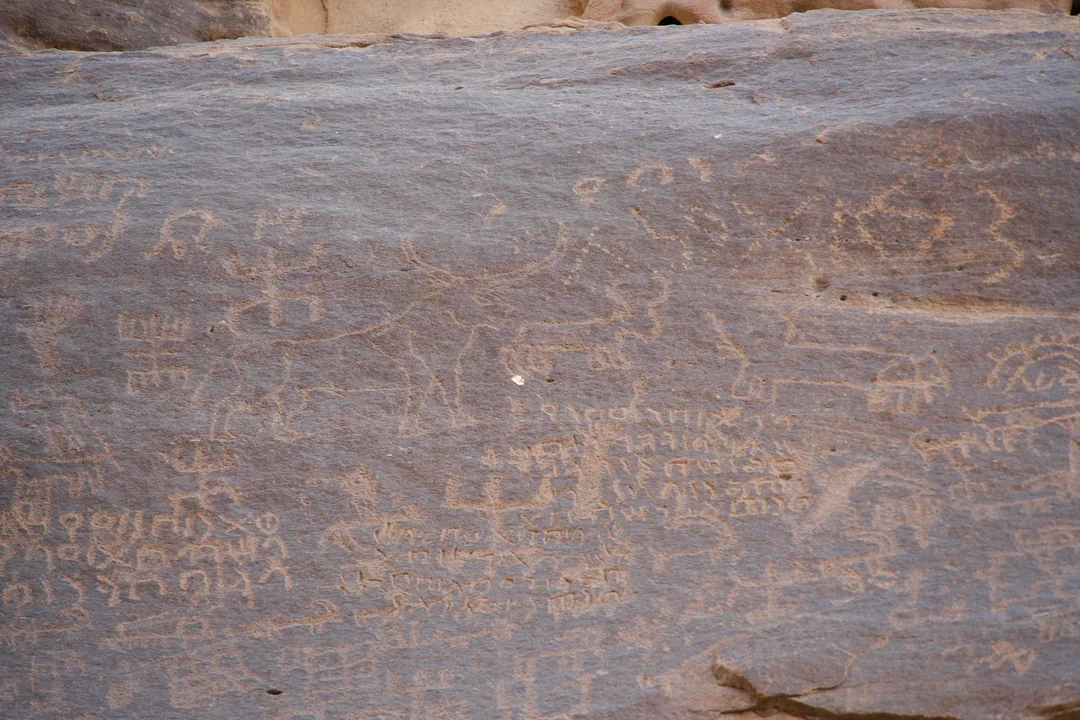
Ancient rock carvings (petroglyphs) in the desert, featuring a prominent ibex with large curved horns, surrounded by numerous inscriptions in an early South Arabian script (Ancient North Arabian or Thamudic).
A close-up photograph of a sandstone rock surface covered with prehistoric and early historic petroglyphs. The central figure is a finely pecked ibex with long, arching horns, depicted in profile. The surrounding area is densely packed with inscriptions in an ancient North Arabian script (likely Thamudic or Early South Arabian), consisting of short texts, tribal marks (wasm), and abstract symbols. The rock shows natural weathering and a warm desert patina, typical of sites in the Arabian Peninsula such as the Hisma Basin or the region around Wadi Rum.


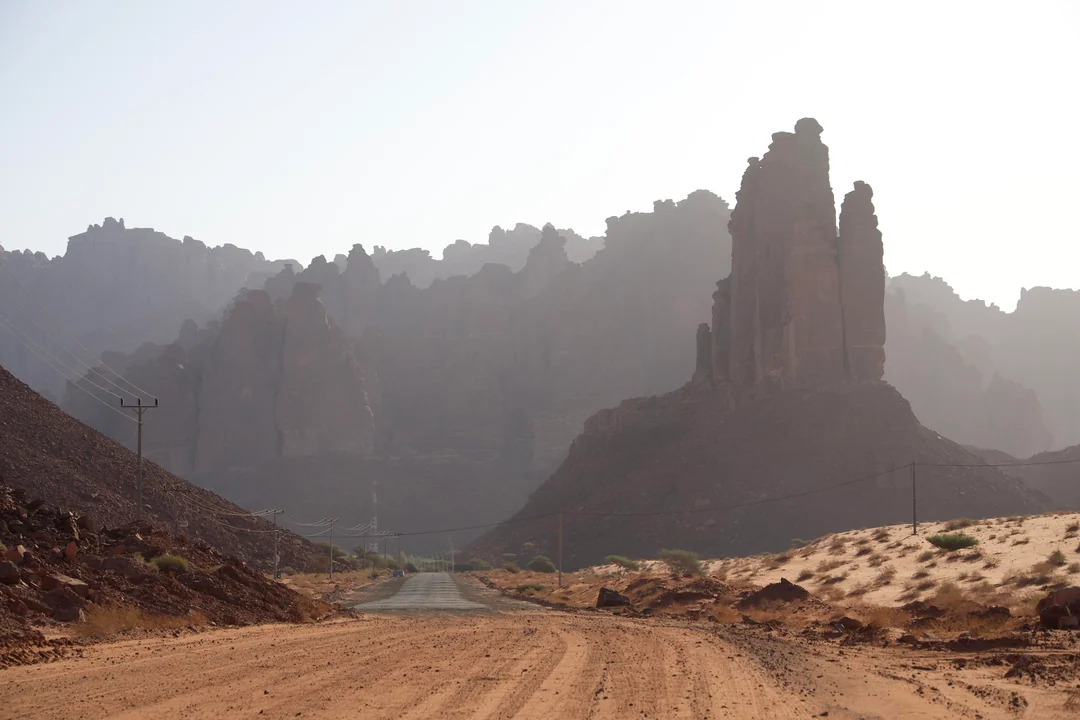
A desert road stretches toward dramatic sandstone cliffs and towering rock pillars under a hazy sky, with power lines running parallel to the track in a remote arid landscape, likely in the Hisma Basin or near Wadi Rum, Jordan.
A wide, empty desert track leads the eye toward a striking range of reddish-brown sandstone mountains. The most prominent feature is a cluster of tall, eroded rock pillars and buttresses rising sharply from the valley floor, their tops jagged against the pale, dusty sky. Sparse vegetation dots the sandy foreground, while a line of electricity poles and wires on the left side hints at a rarely used road through this otherwise untouched wilderness. The atmosphere is dry and hazy, typical of the hyper-arid regions of southern Jordan or northwestern Saudi Arabia.


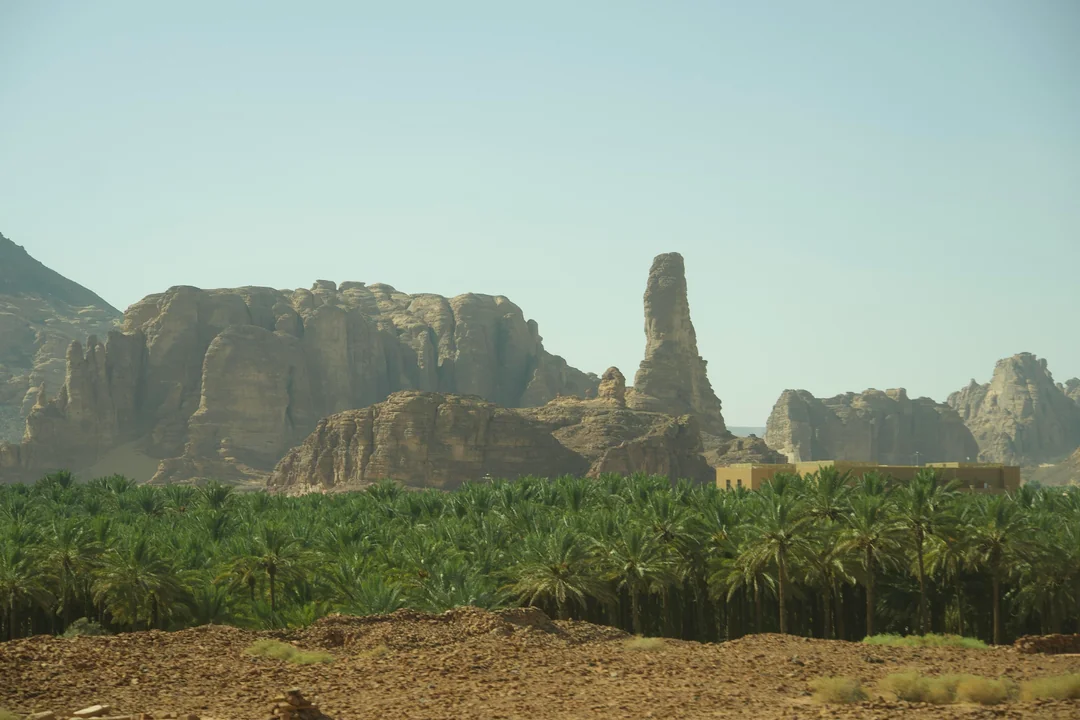
A lush green palm grove in the foreground contrasts with towering sandstone cliffs and a solitary rock pillar rising dramatically against a clear sky in an arid desert region, likely AlUla or Hegra, Saudi Arabia.
A striking desert oasis scene: a dense plantation of date palms fills the lower half of the image, their vibrant green fronds forming a sharp contrast with the barren reddish-brown landscape beyond. In the background, massive eroded sandstone formations dominate the view, with one tall, isolated rock pillar standing prominently like a natural monument. The clear blue sky and bright midday light emphasize the dramatic geological features typical of northwestern Saudi Arabia, particularly the ancient Nabataean region around Hegra (Mada’in Saleh) or the broader AlUla valley.


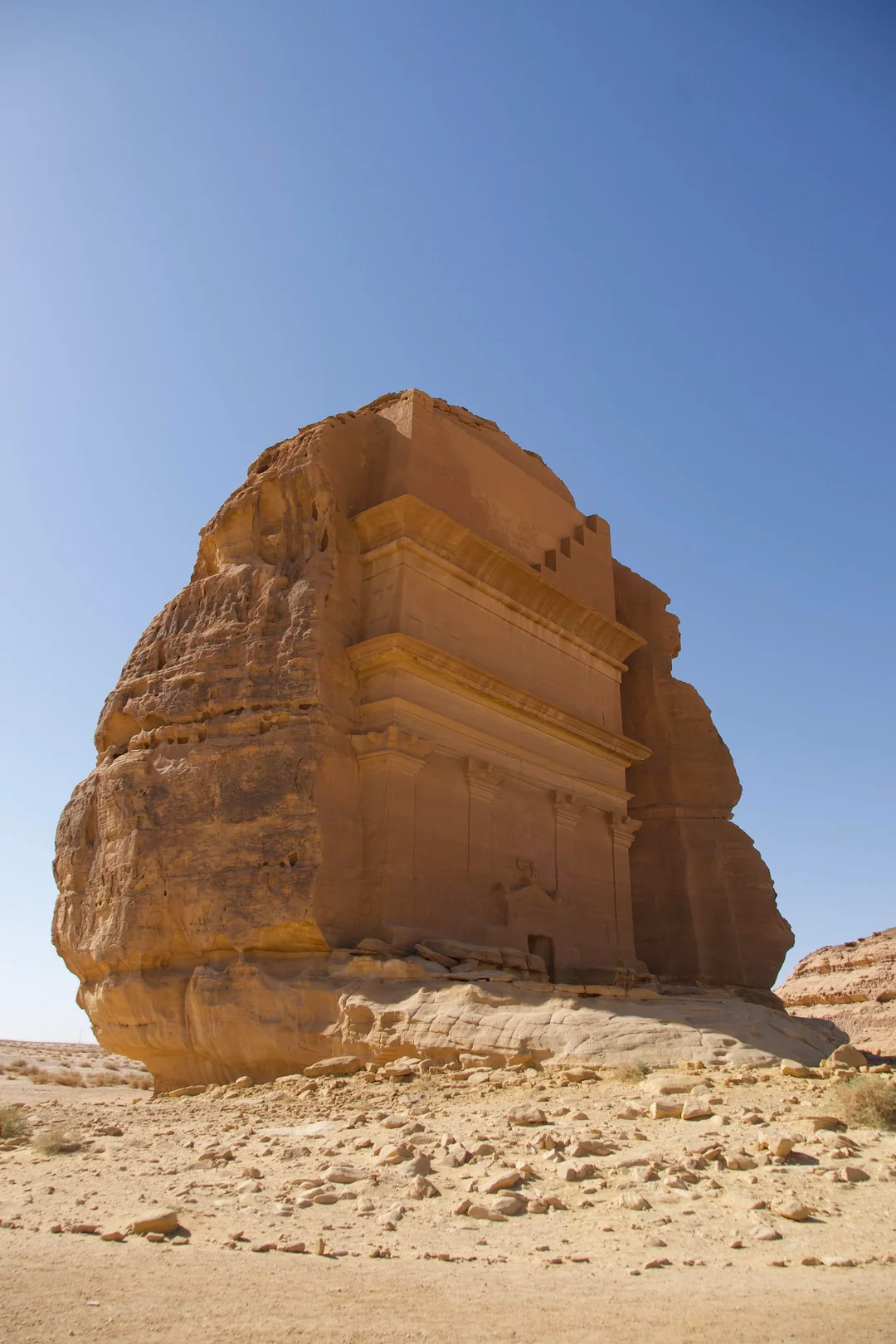
A large sandstone rock with an ancient carved façade standing alone in a desert under a clear blue sky.
The image shows an imposing monolithic sandstone formation in the middle of a barren desert landscape. One side of the rock has been intricately carved into a monumental façade featuring columns, cornices, and geometric details, suggesting it is an ancient tomb or structure. The surrounding ground is sandy and scattered with small rocks and dry vegetation. The sky above is bright and cloudless, highlighting the isolation and grandeur of the carved monument.


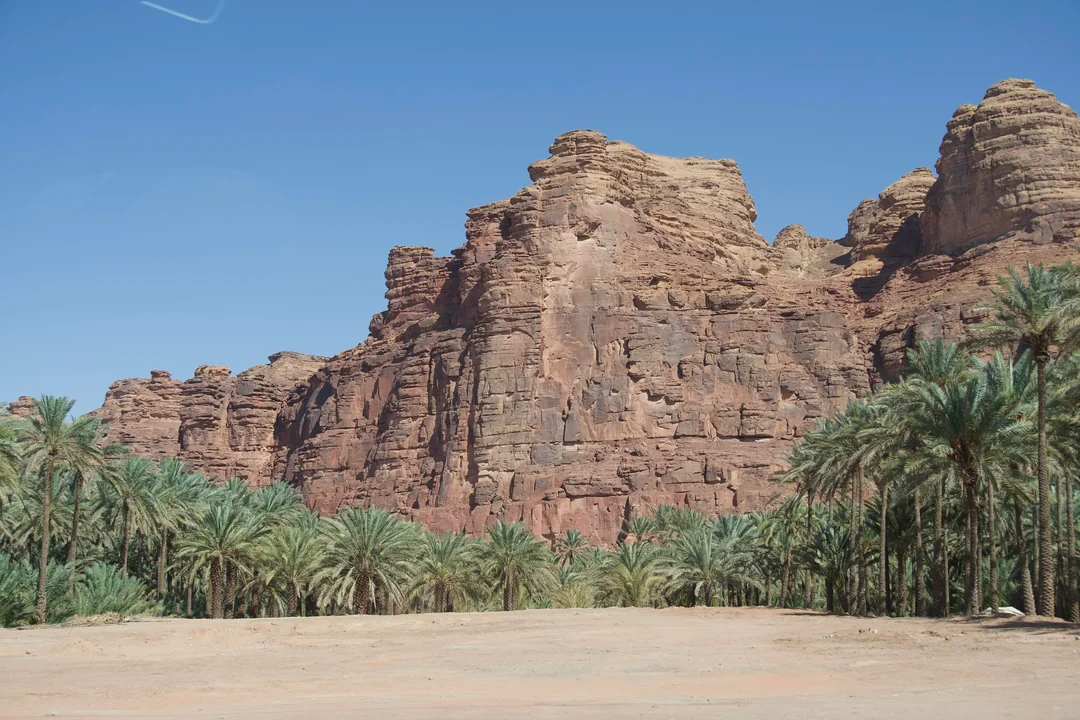
A large reddish-brown sandstone cliff rising behind a dense grove of green palm trees under a clear blue sky.
The image shows an impressive natural landscape dominated by a massive sandstone cliff with rugged, weathered formations in shades of red and brown. At the base of the cliff lies a wide belt of lush green palm trees, creating a striking contrast between the rocky desert terrain and the oasis-like vegetation. The foreground is a sandy, open area, and the sky above is bright and cloudless, adding to the sense of dry desert climate.


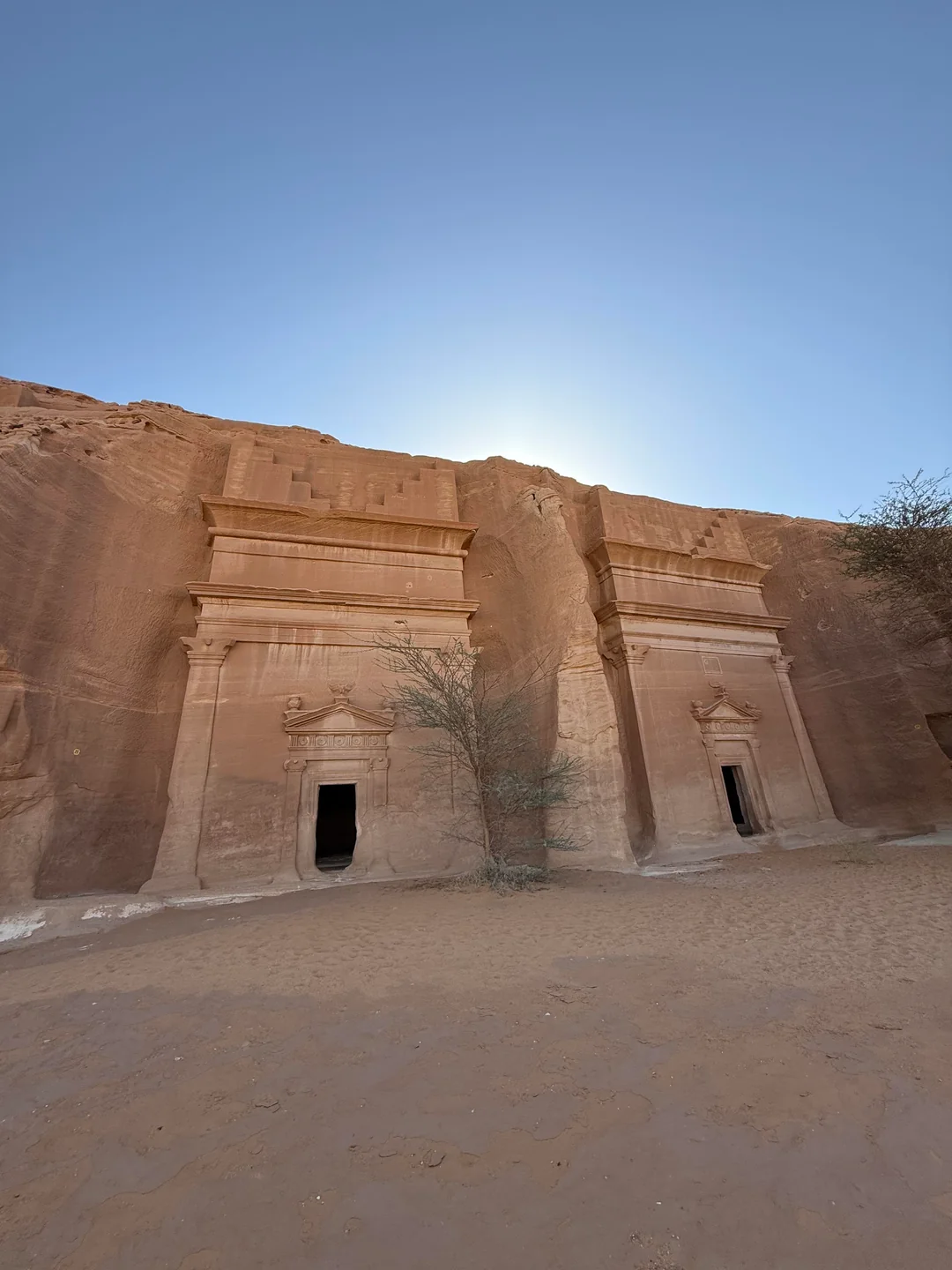
Ancient rock-cut tombs carved into a sandstone cliff under a clear blue sky, with a small tree in front.
The image shows two monumental rock-cut facades carved into a tall sandstone cliff in a desert setting. Each facade features classical architectural elements such as columns, pediments, and decorative carvings. The entrances are dark openings at the base of the structures. A small, leafless desert tree stands in front of the central tomb, and the ground is covered with reddish sand. The sky above is clear and bright, with the sun positioned behind the cliff, creating a halo-like glow.


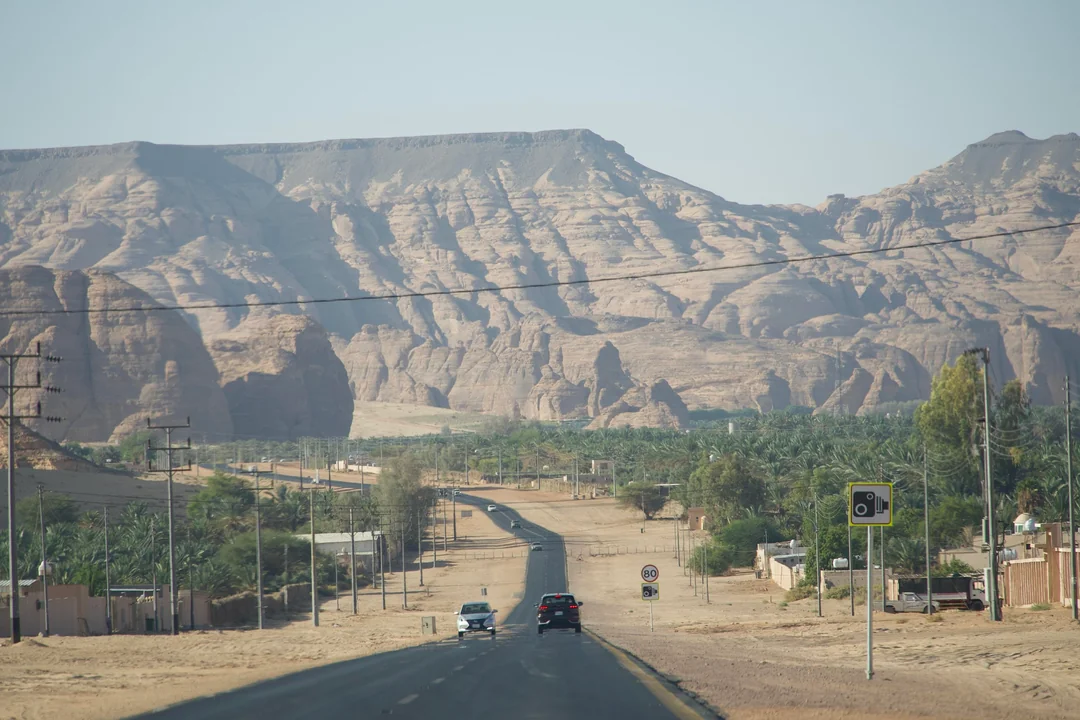
A straight desert highway flanked by palm trees and low buildings, leading toward dramatic layered sandstone mountains under a clear sky in AlUla, Saudi Arabia.
A quiet, sunlit road cuts through an oasis-like strip of greenery in the AlUla valley, northwestern Saudi Arabia. Date palms and small settlements line both sides of the highway, while in the background rise the iconic flat-topped, heavily eroded sandstone escarpments that characterize the region. The pale beige and tan cliffs, sculpted by millennia of wind and water, dominate the horizon, creating a striking contrast between the cultivated foreground and the raw desert geology. The scene perfectly captures the blend of nature and human habitation that defines historic AlUla.


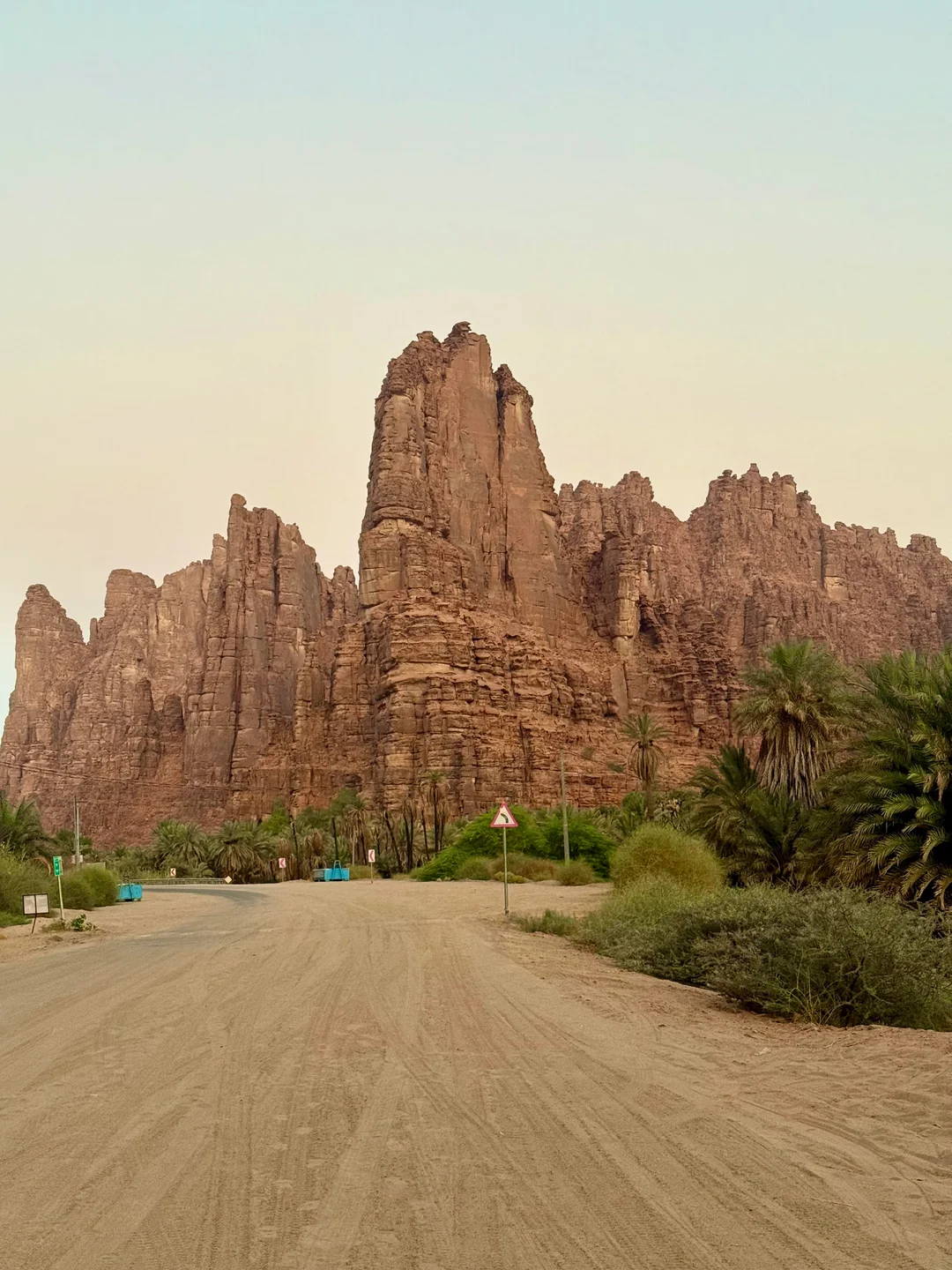
A towering, jagged sandstone cliff rises dramatically above a palm-filled oasis, with a dirt road and yield sign in the foreground, set against a hazy desert sky in AlUla, Saudi Arabia.
An awe-inspiring view of one of AlUla’s iconic sandstone massifs, its vertical rock faces and eroded pillars glowing warm in the soft desert light. At its base, a lush green oasis of date palms and vegetation marks the transition from barren rock to cultivated land. A dusty unpaved road curves through the scene, accompanied by a triangular yield sign, emphasizing the remote and tranquil atmosphere of this UNESCO World Heritage landscape in northwestern Saudi Arabia. The sheer scale and texture of the cliff make it a classic representation of the region’s breathtaking geology.


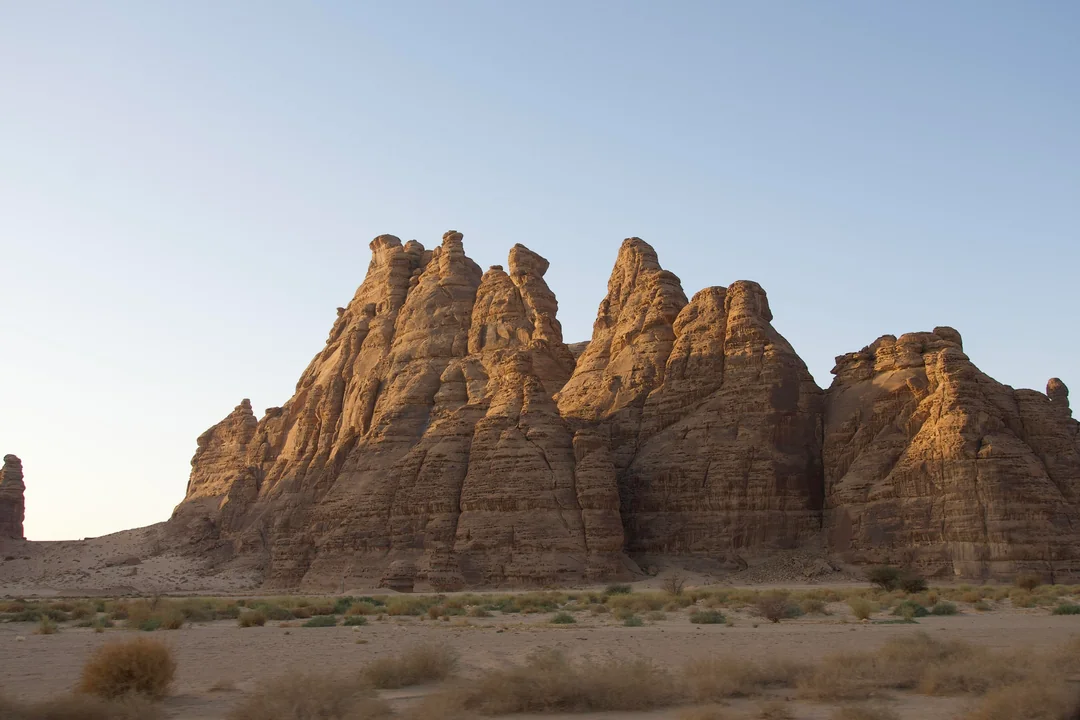
Dramatic cluster of towering, eroded sandstone rock formations with jagged peaks rising from a sandy desert floor under a clear blue sky in AlUla, Saudi Arabia.
A breathtaking view of AlUla’s signature sandstone mountains, sculpted into tall, fantastically shaped pillars and buttresses by millions of years of wind and water erosion. The warm reddish-brown rocks contrast sharply with the pale sand at their base and the deep blue desert sky above. Only a few hardy desert shrubs survive in the foreground, emphasizing the harsh yet stunningly beautiful arid environment of this UNESCO World Heritage region in northwestern Saudi Arabia. The scene captures the raw, otherworldly geology that makes AlUla one of the Arabian Peninsula’s most spectacular landscapes.