
Who built these structures in Ethiopia?
0

Andy Ray
The author of the Uncharted Planet section is an architect and artist, a traveler and researcher, and a proponent of alternative history. Combining professional architectural insight with visual thinking and field observations, he explores ancient civilizations, enigmatic structures, and traces of knowledge that do not fit into widely accepted historical narratives.
Lalibela – city on midnight Ethiopia .One from saints bridge countries,by meaning inferior only Axum,center pilgrimages population countries.On difference from Axum almost all residents Lalibela there are Christians Ethiopian Orthodox churches.By by design Holy Gebre Meskel Lalibeli (Lalibela was Ethiopian emperorXII–XIIIcenturies,canonized Ethiopian church) city must was become New Jerusalem. Now it is world famous for its complex of unique structures carved directly into the rocks.
For centuries, no one raised the question of the origin of the churches of Lalibela, carved from monolithic rock - foreigners did not get here, and the locals always firmly believed that it was the work of angels.
Ethiopia is one of the oldest Christian countries in the world. Christianity became the state religion here in 330 AD (shortly after Armenia). Each of the 11 monolithic structures, like a seal, seals the local landscape, adding to it an unusual expressiveness.
Architecture is upside down (turned inside out) or one that goes deep.
We all accustomed to that,What if under construction some building,then it has be something,What subsequently will be to rise over by land.I I am saying now about buildings,and not about engineering buildings,such as tunnels,shelter and warehouses.Except that,construction we imagine in in the form of stacking one on one some construction elements(brick,stone etc.)for achievement desired result.But here completely other,I b said,phenomenon.IN sculpture there are two main methods — it modeling (modeling),What consists of in building up volume with m'whose materials,and molding(subtractive method),When form is being created by removal unnecessary with solid material(stone,trees).IN modern architecture no method,When form(and in given case building)was created b by removal(clipping)unnecessary with solid material(in given case rocky breed).
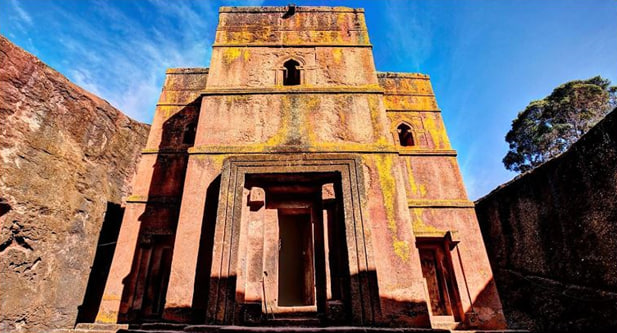
The churches go 40-50 meters underground, with cross-shaped openings cut into their walls at the entrance, and sunlight penetrates through these crosses. There are several theories as to how these striking structures were created, although,for beginning I b answered on such question:it in general What,architecture or sculpture?Architecture by by appointment and sculpture by methods implementation? Some believe that they were built by the Knights Templar, the Crusaders, who in the 13th century, when (Ik consider official historians) these churches were built, just at the zenith of power. But there is no concrete evidence for this theory. Another hypothesis - more common - is that the churches were built by order of the Ethiopian king Lalibela after he returned from Jerusalem and learned about the capture of the Holy Land by Muslim troops.
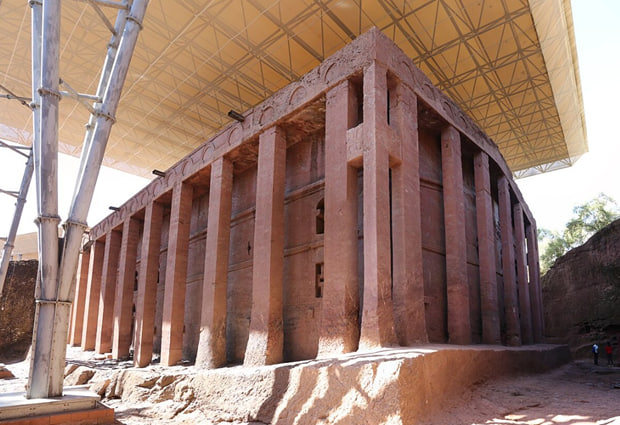
A small local museum seems to support this hypothesis, but not very convincingly. For example, in its exposition there is some kind of axe-like tool, which was supposedly used by temple builders. Even if you discount the fact that the tool is already 900 years old, it still looks more like a device for weeding in the garden than something with which you can chop rock.I,as architect,not I imagine,as all it can was to design,not having modern computer'computers.When I I am watching. on these buildings,then not I imagine,as here are working thousands professional stonemasons from scrapers and chisels.I I imagine itself some machinery type3-d printers,programmed on work over product method removal unnecessary material.
All it was built by one night.
The thousands of local Christians who come to pray in the underground halls of the churches every day adhere to the theory of divine intervention: an entire army of angels was sent to help King Lalibela, who built 11 temples.overnight.
The Incas said the same thing to the Spanish conquistadors in Tiwanaku when they asked who built these amazing structures! Is this a coincidence? How can we explain it? Where is Ethiopia and where is Bolivia?It different continents! The answer was the same: "It all happened overnight."
I specially decided place this material at once by story about Tiwanaku,until we not forgot about this interesting phrase.IN world there are very many different buildings,emergence whose difficult itself imagine even now,as they say,"in century space technologies».THERE ARE and such,as temples in Lalibeli(by technique implementation),there are and yet more impressive,but there already no one not memory'is flying transfers about that,as they arose and who their could build.